


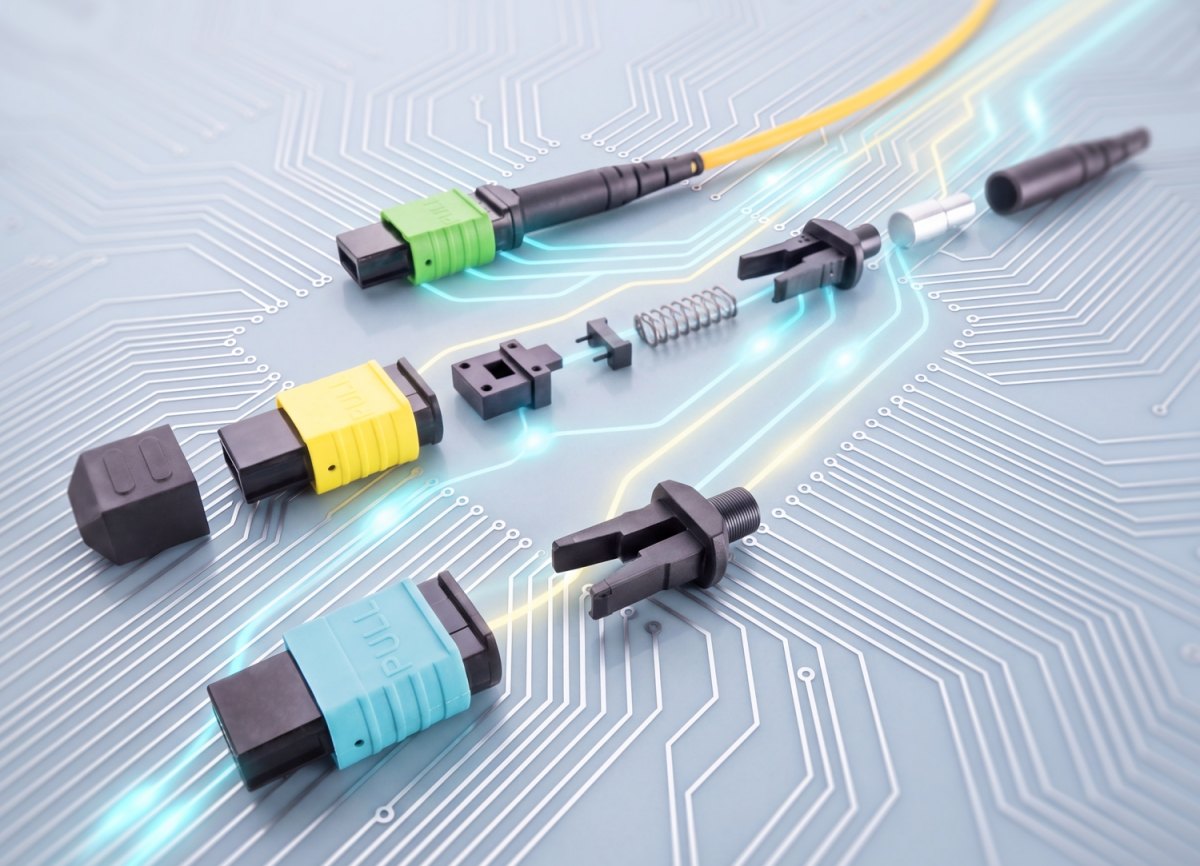
BASF is extending its polyarylethersulfone family Ultrason® into electrical and electronic parts for AI-infrastructure data centres and e-mobility. Fibre-optic connectors, cable jacketing, magnet-wire insulation and thermal-management parts are the targets.
On 13 October 2026 BASF announced it is extending the application scope of its high-performance thermoplastic Ultrason®. The targets are electrical and electronic (E&E) parts used in AI-infrastructure data centres, high-speed connectivity and e-mobility. BASF's reasoning: as AI and cloud computing spread, electronic parts are getting smaller and more densely integrated, and the thermal, mechanical and electrical loads they must carry are growing with them.
The materials are the three polyarylethersulfone (PAES) families Ultrason® E (PESU), S (PSU) and P (PPSU). Citing heat resistance over a wide temperature range, electrical insulation, dimensional stability, inherent flame retardance and chemical resistance, BASF names fibre-optic connectors (FOC), cable jacketing, magnet-wire insulation and thermal-management parts as applications (details below). Colours from translucent to opaque are possible, and BASF positions the family as an alternative to polyetherimide (PEI), polyetheretherketone (PEEK) and polyamide-imide (PAI) in this field.
“BASF aims to establish itself as the leading polysulfone supplier in this field”
Kida said that the spread of AI infrastructure, advanced connectivity and electrification is creating new E&E applications with higher performance demands. BASF is continuing to research new Ultrason® grades and is working with customers worldwide to develop material solutions for AI-driven E&E applications, he added.
Beyond supplying material, BASF says it supports grade selection, part-design optimisation and injection-moulding and extrusion know-how. Ultrason® is offered in grades of differing viscosity: high-flow grades for complex, thin-walled parts, high-viscosity grades for the melt strength extrusion needs. Some grades are available as biomass-balance-certified products with a reduced product carbon footprint.
- Fibre-optic connectors (FOC)
- Ultrason® E (PESU) — stiffness/toughness balance, long-term heat resistance, high flow for thin-walled LC and MPO connectors
- Cable jacketing
- Ultrason® P (PPSU) — extrusion; cables for data-centre and EV transformers
- Magnet-wire insulation
- Ultrason® P (PPSU) — aluminium and copper windings in hot oil up to 200°C
- Thermal-management parts
- Ultrason® — cooling-line fittings, manifolds, fan blades
- Positioned against
- PEI · PEEK · PAI; PFAS-containing polymers in cable jacketing and wire insulation
- Colour
- Translucent to opaque
- Sustainability
- Selected grades biomass-balance certified (reduced PCF)
Source: BASF press release P-26-19 (13 October 2026)
In Korea the announcement lands first with optical-connector makers. LC and MPO connector housings and ferrule holders have wall thicknesses around 1 mm, so a low-viscosity, high-flow grade fits, and in the Ultrason® E family E 1010 (MVR 150) is that grade. For parts that pass through reflow soldering, PESU's glass transition of 225°C gives more margin than PSU (187°C). Note that the announcement speaks to material suitability, not to certification against a specific connector standard such as IEC 61754 — those tests are run at part level.
Cable jacketing and magnet-wire insulation are extrusion processes. BASF cites PPSU for its flexibility, chemical resistance and high-temperature electrical insulation, but extrusion needs a high-viscosity grade. The P 3010 Octud keeps in stock is an injection grade, so extrusion suitability and lead time are confirmed case by case. The 'PFAS-polymer replacement' in the release refers to moving from fluoropolymer jacketing (FEP, PFA and the like) to PPSU — an enquiry that is growing in Korea as well, alongside the EU PFAS restriction debate.
The 'alternative to PEI and PEEK' claim should be read with conditions. Sulfones are amorphous, so they beat PEEK (semi-crystalline) on dimensional stability and transparency and process at lower temperatures, but PEEK leads on continuous-use temperature and chemical resistance. For data-centre cooling fittings in constant contact with glycol-based coolant, hydrolysis resistance is what matters and sulfones are strong there. Semiconductor-process parts exposed to acids and solvents remain PEEK territory. Octud supplies both families and sorts the choice by service temperature, contact medium and transparency requirement.
Colour is a practical item for connector makers. MPO connectors use aqua, yellow, green and magenta to distinguish polarity and fibre type, and because sulfones process at high temperature, ordinary masterbatches shift colour or degrade properties. Avient Colorant Chromatics™, which Octud distributes, is a sulfone-specific colourant — in Korea it is what turns BASF's 'wide colour capability' into an actual part.
Frequently asked questions
Food-contact recertification — from material to documents
Tell us your current material, product category and target market, and we will map the conversion route and the certification documents you need. Evaluation samples are availablf charge.
Related reading
More from us
This article was written by Octud from facts published in BASF press release P-26-19 (13 October 2026). Quoted remarks appear in that release. The photograph is the image supplied with the release. Everything from 'Octud note' onward is Octud's technical commentary and is not part of the release; it does not guarantee certification to any connector standard or Korean stock of extrusion grades. Ultrason® is a registered trademark of BASF; Colorant Chromatics™ is a trademark of Avient.
Tritan™ and Eastar™ are trademarks of Eastman Chemical Company, INFINO® of Lotte Chemical, and Ultrason® of BASF SE. Competitor product names are used solely for factual identification and comparison, and do not imply affiliation or endorsement.