


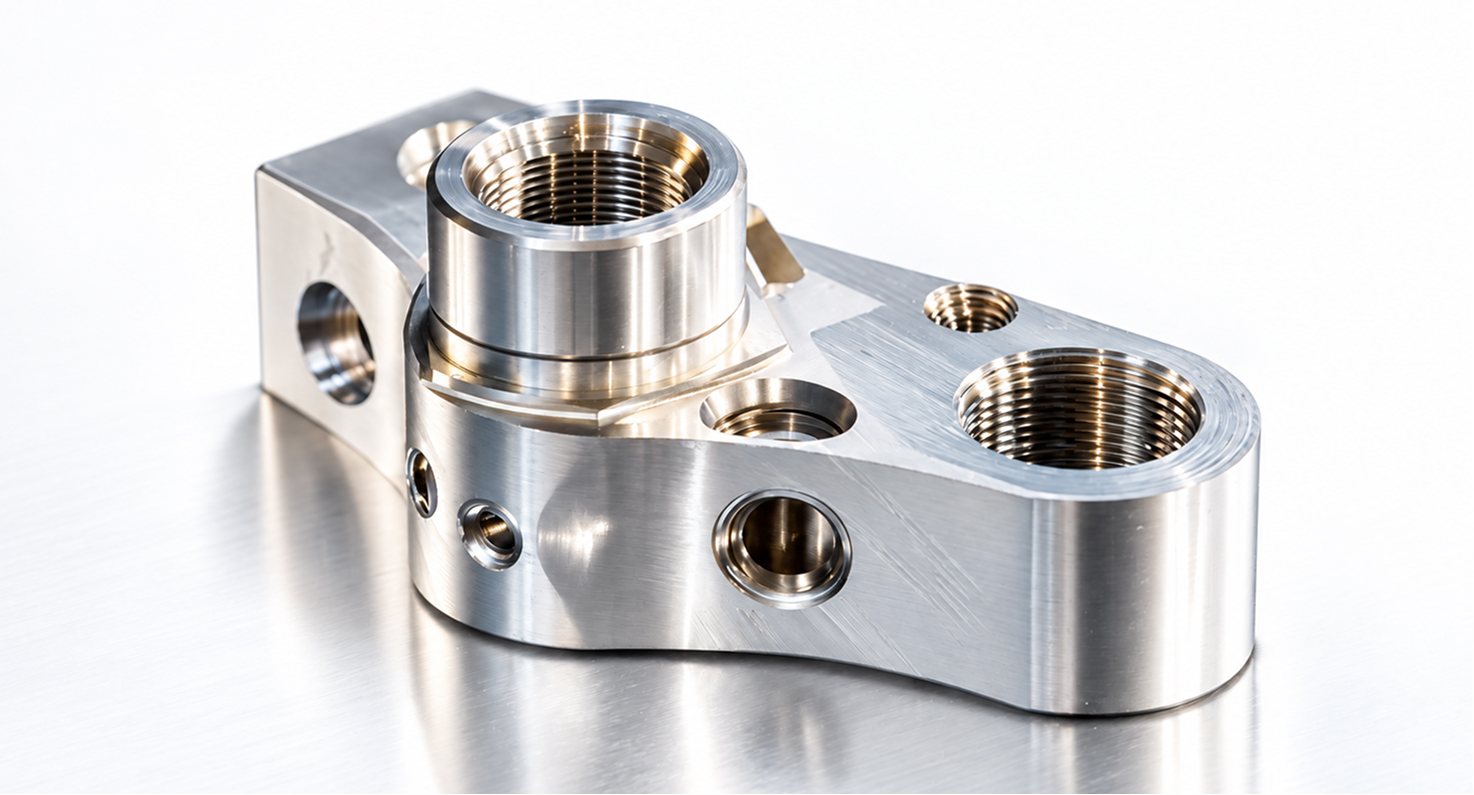
Titanium parts are more often machined than cast or welded. Not because the material is expensive, but because machining is the way to carry titanium's properties into a part at the design values. Why that is, why the machining is hard and costly, and what to settle before you send a drawing.
Titanium parts are cut, not cast
The standard route for precision titanium parts in aerospace, marine, chemical and medical work is CNC machining — computer-controlled milling, turning, drilling and boring from bar, plate, block or forging, producing threads, ports, curved surfaces and deep holes in one part to drawing dimensions.
Benefits: accuracy, geometry, small batches
High dimensional accuracy and repeatability, complex geometry in one setup, and no tooling — so a few prototypes and a batch of hundreds run from the same drawing. It suits stages where the design is still changing.
Hard because of heat and reactivity
Low thermal conductivity concentrates cutting heat at the tool edge, the metal adheres to and wears tools quickly, and a low modulus lets thin walls chatter. Each grade (GR2, Ti-6Al-4V) needs its own conditions; deep holes, thin walls and precision threads need pre-production checks.
CNC machining uses computer numerical control to mill, turn, drill and bore a part out of stock. For titanium the stock is bar, plate, block or forging, and both catalogue items — fittings, flanges, fasteners, subsea housings — and custom parts to customer drawings are made this way. Casting is limited for complex internal geometry and welding leaves a heat-affected zone; machining removes material without changing its structure, so the properties on the mill certificate survive into the part.
The benefits fall into three groups. Accuracy and repeatability: with the same program, part one and part one hundred come out to the same dimensions, and ±0.02 mm-class features can be verified by CMM. Complex geometry: a spherical exterior, an internal thread, side ports and a deep bore can coexist in one part and be finished in one or a few setups. Flexibility: with no tooling, starting from a handful of prototypes and moving to batches of tens or hundreds after validation is natural, and a design change is a program change.
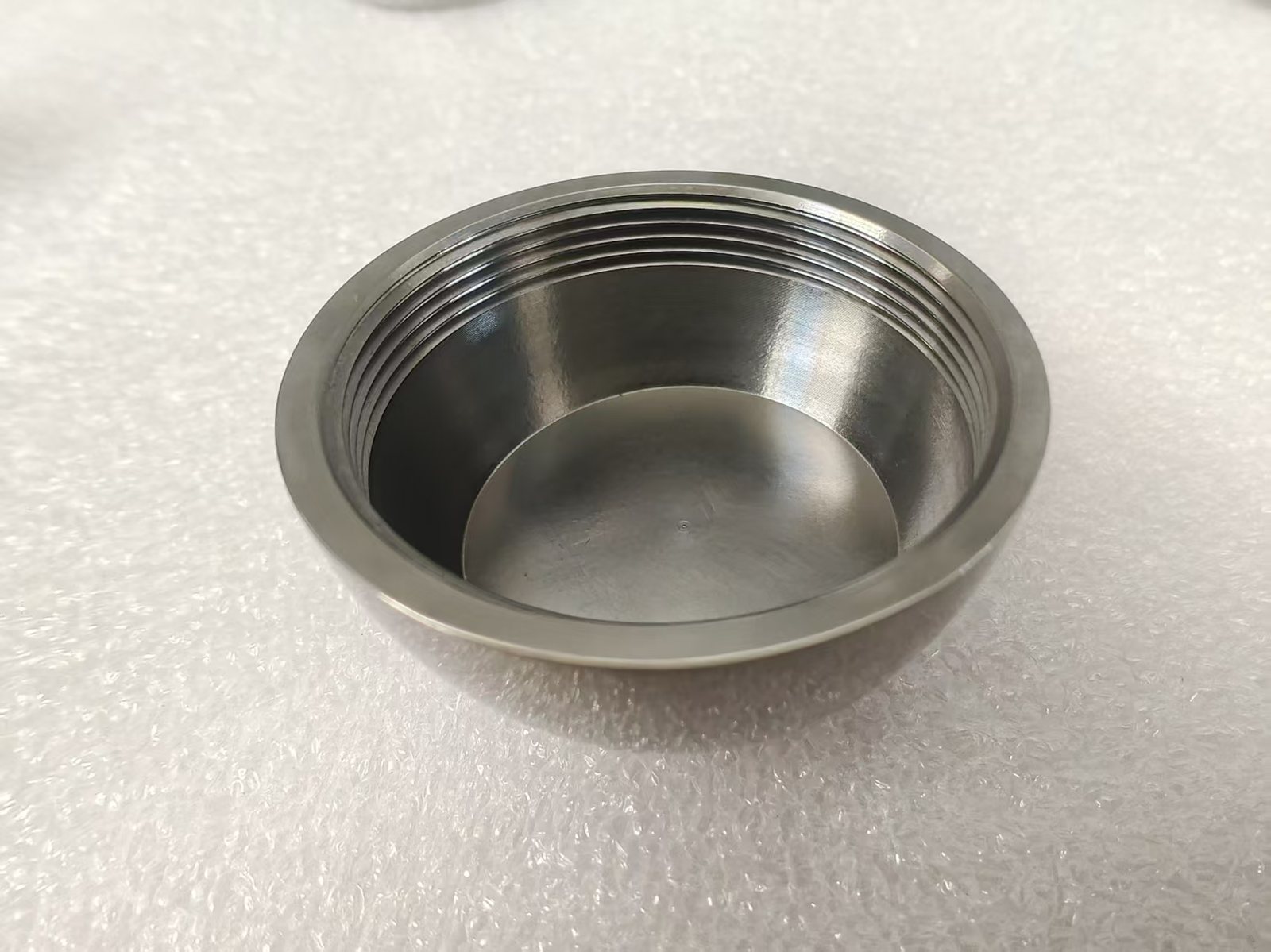
Why is the same process harder and costlier in titanium than in steel or aluminium? First, heat. Titanium's low thermal conductivity means cutting heat cannot escape into the chip or the workpiece and builds up at the tool edge. Second, chemical reactivity: hot titanium reacts with tool materials, chips weld to the edge, and tool wear accelerates. Third, low elastic modulus: under the same cutting force the material deflects more, so thin walls chatter and dimensions wander. Add chip evacuation problems in deep holes and cumulative error over long operations.
Titanium machining therefore runs at lower cutting speeds with maintained feed and generous coolant, and tools are changed often. Commercially pure titanium (GR2) and Ti-6Al-4V (GR5, or GR23 for the medical extra-low-interstitial grade) differ in hardness and strength and cannot be cut with the same parameters. Machining cost is higher than steel not only because of material price but because of this slower pace and tool consumption.
- Thermal conductivity
- Ti-6Al-4V about 7 W/m·K, CP titanium about 17 — carbon steel about 50, aluminium alloys 150–200. Cutting heat concentrates at the tool edge
- Chemical reactivity
- Reacts with tool materials (carbides, coatings) at temperature → chip adhesion, rapid wear. Needs sharp edges and plenty of coolant
- Elastic modulus
- About 110 GPa — roughly half of steel (about 200 GPa). Thin walls and long overhangs deflect under cutting force, causing chatter and dimensional drift
- Density
- About 4.4–4.5 g/cm³ — 57% of steel's 7.85. The same part is lighter (a design benefit, separate from the machining difficulty)
- Chip evacuation
- Chips pack in deep holes and pockets; peck drilling and high-pressure coolant are needed
- Grade differences
- GR2 (CP) is soft and gummy, pushing the edge; GR5 and GR23 (Ti-6Al-4V) are hard, with more heat and tool wear — conditions are set per grade
Source: Representative published property values · metal cutting literature (Ezugwu & Wang 1997 and others)
| Item | CP titanium GR2 | Ti-6Al-4V GR5 · GR23 (ELI) |
|---|---|---|
| Typical standards | ASTM B348 · B265 · F67 (medical) | ASTM B348 · AMS 4928 · F136 (medical, GR23) |
| Tensile strengthspecification minimum | 345 MPa min. | 895 MPa min. |
| Machining character | Soft and gummy, pushes the edge · watch adhesion | Hard, high heat and tool wear · slower speeds |
| Where it fits | Seawater and chemical plant, heat exchangers, fittings and flanges, medical (GR2) | Structural and equipment parts, implants and surgical instruments (GR23) |
| Welding | Easy | Possible (shielding essential) |
Strength minima per ASTM B348 bar. Actual lot values follow the mill test certificate.
Source: ASTM B348 · manufacturer datasheet representative values
Titanium parts in Korea are ordered by two kinds of people: designers converting a stainless or aluminium part to titanium for weight or corrosion, and buyers holding a drawing from an overseas Tier 1 that says Ti-6Al-4V or F136 and looking for a machining source. Both start with the same question — which grade, to which standard, with which documents. Until that is fixed, quotations arrive but cannot be compared.
The environment picks the grade. Parts touching seawater, chloride or acid start from CP titanium (GR2) or the corrosion-resistant alloys (GR7, GR12); load-bearing structural parts are Ti-6Al-4V (GR5). Parts entering the medical device value chain must call out the medical material standard on the drawing — ASTM F136 (Ti-6Al-4V ELI) or F67 (CP titanium). Device approval is obtained at finished-device level by the device maker, but it rests on material standard and traceability (heat number) being in place at part level. A drawing that says only 'Ti-6Al-4V' is quoted as industrial GR5.
Send both a 2D drawing (PDF) and a 3D model (STEP). Projections do not fully capture dimensions such as cavity depth or the concentricity of curved surfaces, and those come back as production queries that stop the schedule. The Ti-6Al-4V ELI housing Octud supplied started from 2D and the samples were made only after the 3D model was added. Keep tight tolerances on the dimensions that need them and leave the rest to general tolerance (ISO 2768-m or similar) — it helps cost. Surface roughness (Ra) and the polished area must be on the drawing before the method can be chosen.
Documents are fixed at order. For titanium the mill test certificate (EN 10204 3.1 — composition, tensile, ultrasonic, PMI) is the baseline, with a dimensional report and, for overseas machining, a certificate of origin. Imported parts can take preferential duty under the China–Korea FTA (titanium machined products, HS 8108.90). Octud supplies these documents per part and delivers in Korea, with small samples → customer test → production as the default sequence. Fixing acceptance criteria and surface requirements on a few samples first is faster in the end than quoting production quantities from day one.
Frequently asked questions
Food-contact recertification — from material to documents
Tell us your current material, product category and target market, and we will map the conversion route and the certification documents you need. Evaluation samples are availablf charge.
Related reading
More from us
※ Written by Octud with reference to a technical note published by its titanium machining partner on 26 October 2026 and the public literature that note cites (Donachie 2000, Davim 2014, Ezugwu & Wang 1997). Property figures are representative published values; actual lot values follow the mill test certificate. Everything after 'Octud note' is Octud's own commentary and not in the source. Photos: Octud. ASTM and AMS are the names of their respective standards bodies.
Tritan™ and Eastar™ are trademarks of Eastman Chemical Company, INFINO® of Lotte Chemical, and Ultrason® of BASF SE. Competitor product names are used solely for factual identification and comparison, and do not imply affiliation or endorsement.